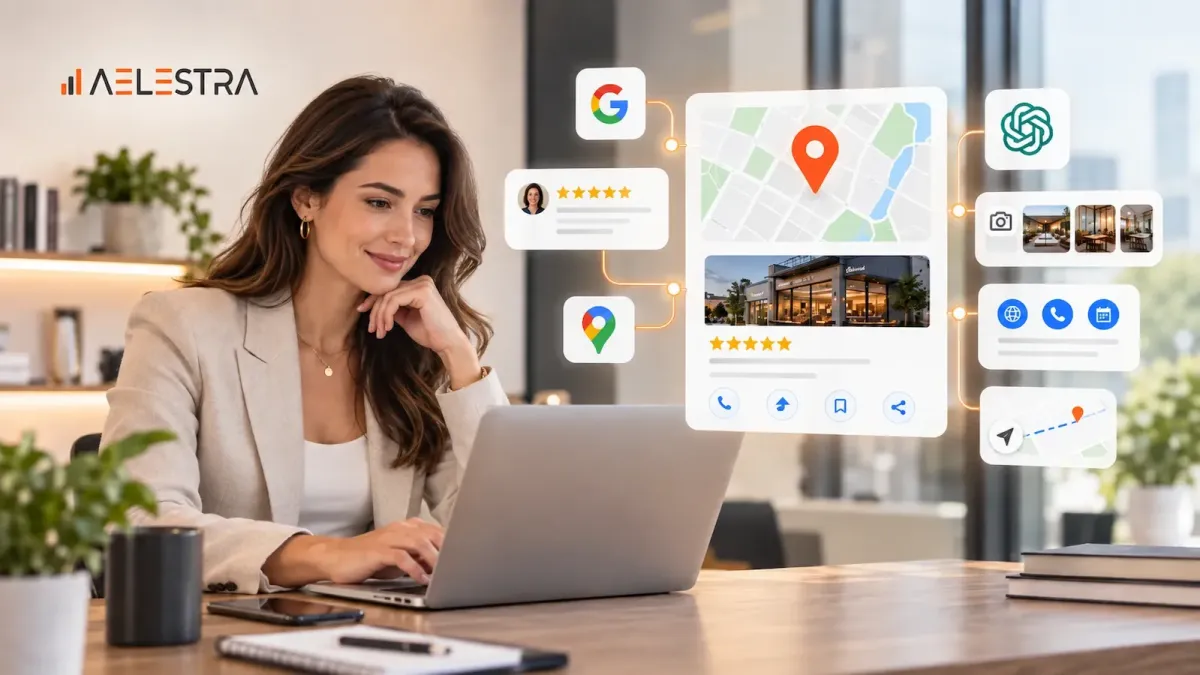
How to Become the Business Google and AI Recommend First
Search Is Changing, but Local Trust Still Wins:
For years, local SEO meant one primary objective:
Appear when someone searches for a business near them.
A restaurant wanted to appear for searches such as “restaurant near me.”
A contractor wanted to appear when someone searched for roofing in their city.
A clinic wanted visibility for nearby services.
A limousine company wanted to appear when travelers searched for transportation in a particular area.
That objective still matters.
But the way people discover businesses is changing.
Customers can now ask increasingly conversational questions:
Where is the best family restaurant near me?
Which local contractor has the strongest reputation for this type of project?
Find a highly rated business nearby that is open tonight.
What company would you recommend for this service in my area?
Instead of simply displaying a list of links, modern search experiences can interpret the request, compare information and help users narrow their choices.
Google Search includes AI-powered experiences.
Google Maps is becoming more conversational.
AI assistants are increasingly being used for local recommendations.
And customers still verify those recommendations using websites, reviews, maps and other sources.
Local SEO is therefore evolving from:
Can Google find my business?
to a more demanding question:
Can search systems clearly understand what my business does, where it operates, whether it is credible and whether it is relevant to this customer's request?
That is the local SEO challenge of 2026.
AI Has Not Replaced Local SEO:
There is a lot of noise around artificial intelligence and search.
New terms appear constantly.
AI optimization.
Answer engine optimization.
Generative engine optimization.
AI visibility.
Some businesses are being told that traditional SEO no longer matters.
That is not what Google itself says.
Google's current guidance states that its foundational SEO practices continue to apply to generative AI features such as AI Overviews and AI Mode. Google also says businesses should continue maintaining accurate Business Profile information and useful, high-quality website content.
This leads to an important principle:
Do not abandon local SEO for AI optimization. Build local SEO strongly enough that AI systems have better information to work with.
The foundations remain remarkably familiar:
Accurate business information.
Relevant content.
Strong reputation.
Helpful website pages.
Customer reviews.
Local authority.
Structured data where appropriate.
Consistent information across the web.
Technical accessibility.
The technology around discovery is changing.
The fundamentals of trust are not.
How Google Determines Local Visibility:
Google officially identifies three primary local ranking considerations:
Relevance
How well does your business match what the person is searching for?
If someone searches for a specific service, Google needs enough information to understand whether your company actually provides that service.
Distance
How close is the business to the searcher or the location referenced in the query?
A company cannot optimize its way out of geography.
Location remains fundamental to local search.
Prominence
How established and well-known does the business appear?
Google explains that prominence can be influenced by information available across the web, including links, articles, directories and reviews. Review volume and positive ratings can also contribute to local ranking.
These three principles are extremely important because AI does not eliminate them.
If anything, increasingly sophisticated search makes having clear, trustworthy information even more valuable.
Your Google Business Profile Is Now Core Search Infrastructure:
For a local business, the Google Business Profile should no longer be treated as an optional directory listing.
Google itself describes the Business Profile as a local storefront on Google Search and Maps.
It provides search systems and potential customers with information such as:
Business name
Address
Service area
Phone number
Website
Opening hours
Business category
Services
Photos
Reviews
Attributes
Other business details
The stronger and more accurate this information is, the easier it becomes for Google to understand the business.
A poorly maintained profile creates uncertainty.
Wrong hours.
Outdated services.
Incorrect categories.
Missing photos.
Old phone numbers.
Inconsistent locations.
All of these weaken the information ecosystem surrounding the business.
Local SEO in 2026 starts with data accuracy.
Google Does Not Learn About Your Business From One Place:
One of the most important concepts in modern local SEO is that Google does not rely exclusively on information entered by the business owner.
Google says Business Profile information can come from several sources, including:
Information provided directly by the business
Publicly available website information
Licensed third-party data
User contributions
Photos and reviews
Google's interactions with local places
This has major implications.
Your website says one thing.
Your Business Profile says another.
A directory lists an old phone number.
Another platform contains an outdated address.
Your social profile uses a different business name.
Now multiple versions of the business exist online.
A strong local SEO strategy reduces this ambiguity.
Your digital presence should reinforce a consistent understanding of:
Who you are.
What you do.
Where you operate.
How customers contact you.
Think Like an Entity, Not Just a Website:
Modern search engines increasingly need to understand businesses as real-world entities.
Your business is not simply a collection of pages.
It has an identity.
A location.
Services.
Customers.
Reviews.
A reputation.
Relationships with other organizations.
A geographic market.
When information across the web reinforces the same entity, search systems can build stronger confidence about what that business represents.
That is why local SEO reaches far beyond adding city names to website titles.
Businesses need an interconnected digital footprint.
Your Website Is Becoming More Important, Not Less:
It is tempting to assume that AI-generated answers will make business websites irrelevant.
Current evidence points in the opposite direction.
Google says generative AI search features still rely on content from its Search index and traditional search ranking and quality systems.
A 2026 third-party study analyzing more than fourteen thousand citations from local queries in Gemini found that business websites accounted for nearly 60% of the citations identified in the study. Results also varied considerably between repeated searches, so this should not be interpreted as a fixed ranking formula, but it provides a useful signal: the official business website remains a major source of local information for AI-powered discovery.
Your website is where you can clearly explain:
What you offer.
Who you serve.
Where you operate.
Why customers choose you.
What makes your services different.
What questions customers commonly ask.
What expertise your company has.
What evidence supports your credibility.
Your website is not competing against AI.
It is potentially feeding the information environment AI uses to understand your business.
Build Pages Around Real Services and Real Locations:
A local business website should answer the questions customers actually search.
That usually requires more than one generic services page.
Imagine a contractor serving several areas.
A weak website might say:
“We provide quality contracting services throughout the region.”
A stronger site explains individual services clearly.
Roofing.
Renovation.
Commercial projects.
Emergency work.
Specific service areas.
Project examples.
Frequently asked questions where useful.
Each important service should have enough meaningful information for both customers and search systems to understand it.
The same applies to location.
Do not create hundreds of thin city pages that simply replace one city name with another.
That creates little real value.
Instead, build location content when your business genuinely serves that market and can provide useful, differentiated information.
Quality remains more important than page quantity.
Reviews Are Search Signals and Decision Signals:
Reviews have two jobs.
They help search systems understand reputation.
And they help customers decide whether they trust you.
Google explicitly says review count and positive ratings can help local ranking.
But the customer side is becoming even more interesting.
BrightLocal's 2026 research found customers increasingly expect strong ratings and recent reviews, while generic or delayed responses can create negative impressions.
This means reputation management is no longer only about maintaining a nice star rating.
The review ecosystem communicates:
Service quality.
Customer experience.
Popular services.
Locations.
Staff interactions.
Common strengths.
Recurring problems.
Responsiveness.
Real-world customer language.
Every review contributes another piece of public information about the company.
Do Not Chase Reviews. Build a Review System.
Businesses often make review generation inconsistent.
They remember to ask one week.
Then forget for two months.
Then suddenly request twenty reviews.
A better strategy creates a repeatable process.
After a legitimate customer experience:
Ask at an appropriate moment.
Make leaving feedback easy.
Do not incentivize dishonest reviews.
Monitor incoming reviews.
Respond professionally.
Identify recurring themes.
Resolve operational issues where necessary.
The objective is a healthy, ongoing stream of genuine customer feedback.
Freshness matters because customers want evidence that the business is performing well now, not only three years ago.
Review Responses Matter Too:
Responding to reviews is not busywork.
Google specifically recommends responding to customer reviews and says useful replies demonstrate that the business values feedback.
A strong response should:
Recognize the specific feedback.
Sound human.
Match the situation.
Avoid obvious templates.
Remain professional.
Handle negative experiences calmly.
Never expose private customer information.
For positive reviews, reinforce what customers appreciate.
For negative reviews, acknowledge the experience and move sensitive resolution into an appropriate private channel.
Your responses become part of your public reputation.
AI Is Becoming a Local Discovery Channel:
This is where 2026 becomes especially important.
BrightLocal reported that 45% of surveyed consumers had used AI tools for local business recommendations during the previous year, compared with 6% in the prior year's research.
That does not mean AI has replaced Google Maps.
It means local discovery is becoming multi-channel.
A customer may:
Ask an AI assistant.
Check Google.
Read reviews.
Visit your website.
Open Maps.
Look at Instagram.
Then decide.
BrightLocal separately found that three-quarters of consumers used multiple channels during their most recent local business search.
Businesses therefore need consistency across the entire discovery journey.
Customers Still Verify AI Recommendations:
AI recommendation does not automatically equal trust.
BrightLocal's research found that many consumers continue verifying recommendations through other sources, and 88% of consumers using AI for local recommendations reported fact-checking reviews referenced by AI tools.
This creates a powerful sequence:
AI discovers you.
The customer verifies you.
Your digital reputation confirms or weakens the recommendation.
Imagine an AI tool recommends a restaurant.
The customer checks Google.
The hours are wrong.
The newest photos are two years old.
Reviews are unanswered.
The website barely works on mobile.
Trust collapses.
Visibility alone is not enough.
Your digital presence needs to survive verification.
Google Maps Is Becoming Conversational:
Google Maps is also moving beyond traditional keyword search.
In March 2026, Google announced Ask Maps, powered by Gemini, allowing users to ask more complex conversational questions about places and receive personalized recommendations. The feature began rolling out in the United States and India.
This represents an important shift.
Instead of:
Italian restaurant Montreal
customers increasingly interact with systems using queries closer to natural conversation:
Find somewhere nearby with good Italian food that works for a family dinner and is open late.
That requires search systems to understand multiple attributes simultaneously.
Businesses with richer, clearer and more consistent digital information are better positioned to be understood in these contexts.
Optimize for Questions, Not Only Keywords:
Keywords still matter.
But businesses should also consider the questions behind those keywords.
A customer searching for:
dentist near me
might actually need:
A dentist open Saturday.
Emergency dental care.
A dentist accepting new patients.
A clinic with strong reviews.
A location close to work.
A business website should answer those real questions.
This does not require writing robotic pages for every possible query.
It requires creating genuinely useful content that explains the business completely.
Structured Data Helps Search Engines Understand Your Business:
Structured data is another useful part of local SEO.
Google supports LocalBusiness structured data, which can communicate structured information about local organizations and their locations.
Depending on the business, structured data may describe things such as:
Business identity.
Address.
Opening hours.
Telephone.
Business type.
Other relevant properties.
But there is an important 2026 distinction.
Google explicitly says there is no special AI schema required to appear in AI Overviews or AI Mode.
Use structured data because it helps search engines interpret your website and supports eligible search features.
Do not expect it to be a secret button for AI recommendations.
Stop Looking for AI SEO Shortcuts:
The emergence of generative search has created plenty of questionable tactics.
Mass-producing low-value pages.
Creating fake mentions.
Stuffing AI-oriented phrases into websites.
Publishing hundreds of near-duplicate articles.
Adding unnecessary files supposedly required by AI crawlers.
Google's 2026 guidance directly pushes back against several of these ideas.
There is no special page length required.
There is no need to rewrite content purely for AI systems.
There is no special structured markup for AI Search.
Google also clarified that maintaining an llms.txt file neither helps nor hurts visibility in Google Search.
The stronger strategy is much less glamorous:
Become genuinely useful, technically accessible, locally relevant and trustworthy.
Build Local Authority Beyond Google:
Your Business Profile matters enormously.
But local authority should not depend on one platform.
Google itself says prominence can incorporate signals from across the web, including links, articles and directories.
Useful authority signals can come from legitimate sources such as:
Local news coverage.
Industry organizations.
Business associations.
Relevant directories.
Community organizations.
Partners.
Suppliers.
Professional organizations.
Local sponsorships.
Real publications.
The emphasis should be on legitimate relevance, not manufacturing hundreds of low-quality links.
Business Information Consistency Still Matters:
Your core business information should remain consistent wherever appropriate.
Business name.
Address.
Phone.
Website.
Hours.
Service areas.
Categories.
If a business moves, changes its phone number or modifies its hours, updating only the website is not enough.
Old information can remain across multiple platforms.
Consistency reduces confusion for both customers and automated systems.
Mobile Experience Is Local SEO:
Local searches frequently happen when customers are ready to act.
They want to:
Call.
Navigate.
Book.
View a menu.
Request a quote.
Check hours.
Send a message.
The website therefore needs to work extremely well on mobile.
Fast loading.
Clear contact information.
Readable content.
Large actionable buttons.
Simple navigation.
Easy booking.
No intrusive friction.
A business can earn visibility and still lose the customer because the mobile experience is poor.
Local SEO Is Also Conversion Optimization:
Ranking number one is not the final objective.
Customers still need to choose you.
Imagine two businesses appearing beside one another.
Business A has:
Incomplete information.
Few photos.
Old reviews.
A slow website.
Confusing services.
Business B has:
Clear services.
Recent photos.
Strong reviews.
Professional responses.
Accurate hours.
Easy booking.
A polished website.
Both obtained visibility.
Only one built confidence.
That means local SEO should be measured not only by rankings, but also by:
Calls.
Website visits.
Bookings.
Directions.
Qualified leads.
Sales.
Revenue.
A 2026 Local SEO Framework:
A practical strategy can be organized into seven layers.
1. Establish
Verify and correctly configure your business presence.
2. Clarify
Make it unmistakably clear what you offer and where you operate.
3. Connect
Keep your website, Business Profile and important listings aligned.
4. Prove
Build genuine reviews, useful content, relevant links and authority.
5. Enrich
Add quality photos, services, location information and structured business data.
6. Monitor
Track reviews, rankings, website activity, leads and customer behavior.
7. Improve
Use what customers search, ask and review to strengthen the business continuously.
This creates a much stronger local-search ecosystem than chasing individual ranking tricks.
The Local Visibility Flywheel:
Strong local visibility becomes self-reinforcing.
A customer discovers your company.
They visit your website.
They become a customer.
They leave a genuine review.
The review strengthens trust.
The business becomes more established.
More customers discover it.
More customer experiences create more reputation signals.
The cycle continues.
Local SEO works best when marketing and operational quality reinforce each other.
You cannot permanently optimize around a weak customer experience.
Eventually, reputation reflects reality.
What Should Businesses Track?
Do not rely only on a single keyword ranking.
Local search results change based on location, intent and other contextual factors.
Instead, track a portfolio of outcomes:
Business Profile visibility.
Website organic traffic.
Calls.
Direction requests.
Form submissions.
Bookings.
Lead quality.
Search queries.
Review volume.
Review recency.
Average rating.
Review response rate.
Conversions.
Revenue attributed to local discovery.
You are not optimizing for a screenshot.
You are optimizing for business growth.
How AELESTRA Helps Build a Stronger Local Presence?
Local visibility becomes difficult when every part of the customer journey operates separately.
Business listings are managed in one place.
Reviews somewhere else.
Website leads enter another system.
Appointments use another platform.
Customer conversations are fragmented.
Follow-ups happen manually.
AELESTRA helps businesses connect more of these activities into one ecosystem.
Businesses can manage important parts of their digital presence, customer relationships, reviews, website interactions, conversations, CRM activity, bookings and follow-up from a more connected environment.
This matters because local SEO does not end when someone discovers your business.
Discovery should become a conversation.
The conversation should become a customer.
The customer experience should create reputation.
And reputation should strengthen future discovery.
That is the cycle modern local businesses need to build.
Final Thought: Become the Business Search Systems Can Trust
The future of local SEO is not about tricking an algorithm.
It is about reducing uncertainty.
Search engines need to understand you.
AI systems need reliable information.
Customers need evidence.
Your business needs consistency.
When all four align, your company becomes easier to discover and easier to recommend.
So the competitive question for 2026 is no longer simply:
How do I rank higher?
It is:
How do I become the clearest, most relevant and most trusted answer in my market?
Build that foundation correctly and visibility becomes the result.
Not only in traditional search.
Not only in Maps.
But across the expanding world of AI-assisted local discovery.
#LocalSEO #LocalSEO2026 #GoogleBusinessProfile #GoogleMaps #AISearch #LocalSearch #GoogleMapsSEO #ReputationManagement #GoogleReviews #SearchMarketing #SmallBusinessMarketing #LocalBusiness #DigitalMarketing #AELESTRA