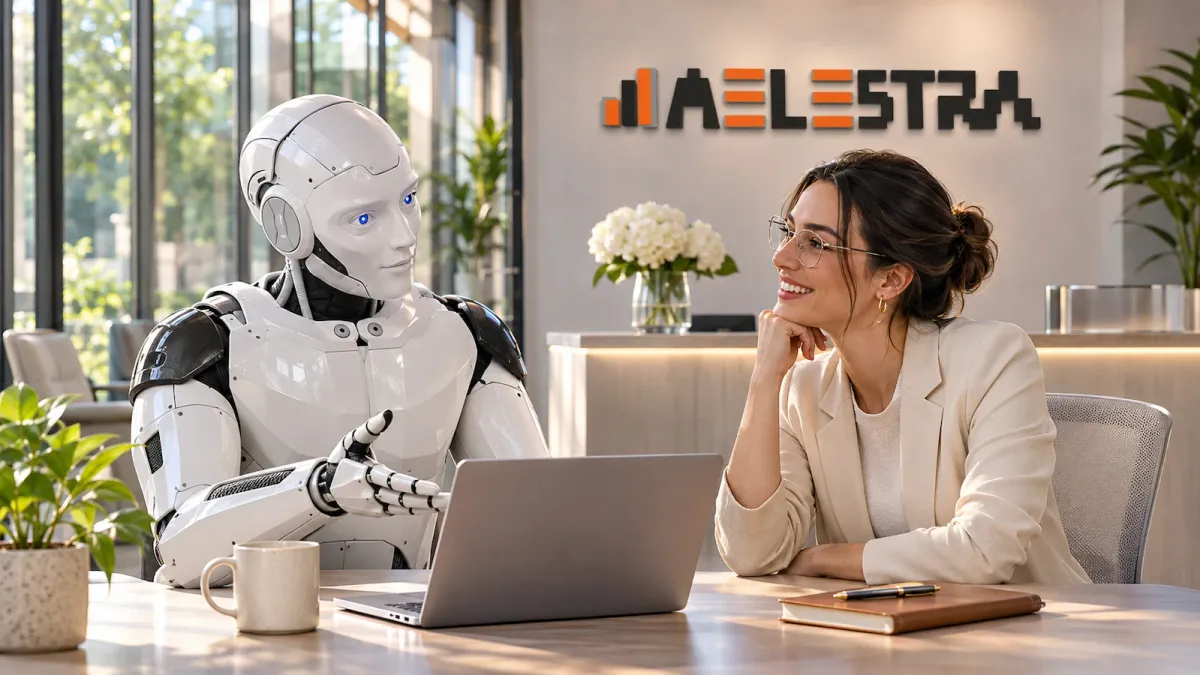
AI Receptionist vs. Answering Service: Small Business Guide 2026
The Next Customer Who Calls Your Business May Never Call Twice
A potential customer finds your company online.
They like what they see.
They have a question before booking.
They pick up the phone.
It rings.
Nobody answers.
They try another business.
You may never know that opportunity existed.
For small businesses, answering the phone is not simply an administrative task. It is often the first step in acquiring a customer, securing an appointment or building trust.
But maintaining reliable phone coverage creates a difficult operational question.
Should you hire a receptionist?
Use a traditional live answering service?
Or introduce an AI receptionist that can answer incoming calls and assist customers automatically?
In 2026, all three options are viable.
However, the most advanced technology is not automatically the best solution for every business.
The right decision depends on the complexity of your customer conversations, your call volume, your operating hours, your budget and how your business manages the information collected during each call.
Understanding those differences is essential.
What Is an AI Receptionist?
An AI receptionist is a voice-powered software system designed to answer telephone calls and interact with callers using conversational artificial intelligence.
Unlike a traditional prerecorded phone menu, a modern AI receptionist can interpret natural language and respond according to its configured business information, instructions and connected tools.
Depending on the platform and implementation, it may be able to:
Answer incoming calls automatically.
Explain business hours, locations and services.
Respond to frequently asked questions.
Collect customer contact information.
Identify the purpose of a call.
Qualify potential customers.
Check appointment availability through a connected calendar.
Book appointments during a conversation.
Update customer records inside a CRM.
Trigger approved follow-up workflows.
Transfer conversations to a human representative.
Support multiple languages.
The important distinction is that an AI receptionist does not necessarily stop at answering.
When properly integrated, it can turn a phone conversation into an operational action.
For example, someone calling a service company may be able to explain what they need, provide the necessary details and request a consultation without waiting for a team member to become available.
But these capabilities are not universal.
An AI receptionist can only complete actions supported by its actual integrations, permissions, available data and configuration.
A convincing voice alone does not make a system operationally intelligent.
What Is a Traditional Answering Service?
A traditional answering service provides real people who answer incoming business calls on behalf of another company.
Rather than hiring an additional employee, the business contracts with an external service that follows its instructions.
Depending on the provider and plan, human agents may:
Greet callers professionally.
Take and forward messages.
Answer common questions.
Route important calls.
Conduct basic customer intake.
Schedule appointments.
Handle overflow calls.
Provide after-hours or round-the-clock coverage.
Some live answering services operate as basic message-taking providers.
Others provide sophisticated virtual receptionist services with appointment scheduling, customer qualification and software integrations.
That distinction matters.
A traditional answering service is not necessarily limited to taking messages, just as an AI receptionist is not necessarily capable of completing every request.
The quality of each solution depends on the service you actually purchase.
What About an In-House Human Receptionist?
There is a third option: hiring a dedicated receptionist or maintaining a human front-desk team.
This approach offers advantages that technology and external answering providers cannot always replicate.
An employee who works directly inside your organization may understand:
Your customers.
Your employees.
Your internal processes.
Your service exceptions.
Your company culture.
Your changing daily priorities.
That context becomes valuable when calls require discretion, judgment or immediate coordination with an internal team.
However, a dedicated employee also has limited working hours, takes breaks and cannot generally manage several live conversations simultaneously.
An in-house receptionist may be the right foundation for a high-touch business, while AI or an answering service provides support during periods when that person is unavailable.
AI Receptionist vs. Traditional Answering Service vs. In-House Receptionist
Decision factor | Live answering service | In-house receptionist | |
|---|---|---|---|
Availability | Can operate 24/7 if configured | Depends on contracted coverage | Limited by staffing |
Routine questions | Strong with accurate knowledge | Strong with good training | Strong with internal knowledge |
Appointment scheduling | Requires supported calendar integration | Depends on provider integration | Usually handled directly |
Complex situations | Requires escalation | Human judgment available | Strongest internal context |
High call volume | May support concurrent calls | Depends on staffing and capacity | Limited by available staff |
CRM updates | Can be automated through integration | Depends on provider and integration | Manual or software-assisted |
Consistency | Governed by configuration and knowledge | Depends on training and agents | Depends on employee processes |
Personal relationship | Limited by conversational capabilities | Human interaction | Direct relationship with the business |
Cost structure | Subscription and/or usage charges | Often minutes, calls or service packages | Salary and employment costs |
Best application | Routine, repeatable call workflows | Outsourced human interaction | Complex internal coordination |
The right choice is rarely determined by a single row in this comparison.
A business should evaluate which tasks matter most to its customers.
1. Availability: Can Your Business Answer When Customers Actually Call?
One of the clearest advantages of an AI receptionist is its ability to provide coverage beyond normal working hours.
For businesses receiving calls during evenings, weekends or busy service periods, this can be valuable.
Consider a plumbing company.
Its technicians spend most of the day visiting customers.
They cannot always answer the phone while completing a job.
A customer calls to request an estimate.
An AI receptionist could collect the service request and arrange an appropriate next step.
Now consider a wellness clinic.
Its reception team may be busy assisting customers who are already at the location.
An AI receptionist could help manage incoming appointment inquiries when the team cannot pick up.
However, a traditional answering service may also provide 24-hour coverage.
Therefore, the real comparison is not simply AI versus human availability.
It is:
What level of coverage can your business afford, and what can happen during those covered hours?
An answered call is useful.
An answered call that leads to the correct next step is more valuable.
2. Appointment Booking: The Difference Between Taking a Request and Completing It
Appointment scheduling is one of the most practical use cases for AI voice agents.
But there is a major difference between an AI system saying it can help with booking and actually creating a confirmed appointment.
A properly connected appointment workflow should:
Identify the service the caller needs.
Determine the appropriate appointment type.
Check real calendar availability.
Offer valid time slots.
Collect only necessary customer details.
Confirm the caller's selection.
Create the appointment successfully.
Communicate confirmation only after the calendar system confirms the booking.
A system should never invent an available appointment time.
It should never tell a customer that a booking is complete when the booking action failed.
This distinction is essential for customer trust.
A traditional answering service can also handle appointments, provided its representatives have access to the relevant scheduling system and the service includes that responsibility.
An in-house receptionist may offer additional flexibility when coordinating unusual requests or last-minute operational changes.
The question to ask is not whether a service offers appointment booking. It is how accurately and reliably it completes the booking.
3. Customer Experience: Speed Is Important, but So Is Understanding
AI receptionists can provide immediate responses to predictable questions.
For example:
What time do you open?
Where are you located?
Do you offer consultations?
Can I schedule an appointment?
What services do you provide?
These conversations are often structured and relatively easy to standardize.
But customers are not always calling with predictable requests.
Some callers are confused.
Some are upset.
Some have complex questions.
Some need reassurance.
Others may have situations that fall outside the company's established policies.
Research continues to show that human interaction remains important.
In February 2026, Metrigy reported that approximately 85% of respondents in its United States and Canada study preferred interacting with a human rather than an AI customer service agent.
At the same time, respondents recognized useful applications for AI, including routing, confirmations and appointment scheduling.
This is an important distinction.
Customers can appreciate the convenience of automation while still preferring human judgment when the situation becomes more complicated.
The best customer experience does not require a business to choose between efficiency and empathy.
It requires the business to understand when each is needed.
4. Human Escalation: The Feature Every AI Receptionist Should Have
Human escalation should never be treated as an optional extra.
It should be part of the system's design.
An AI receptionist should have clear rules for situations that require human assistance.
Examples include:
A caller explicitly requests a person.
The AI cannot understand the request after reasonable clarification.
The customer becomes frustrated.
A complaint requires investigation.
A high-value opportunity needs a sales specialist.
The request involves sensitive information.
The situation requires a decision outside approved business rules.
An appointment or operational action fails.
The ideal experience is simple.
The AI identifies that human support is needed.
It transfers the call when an appropriate team member is available.
Relevant context accompanies the handoff when supported.
And the customer is not unnecessarily forced to explain everything again.
If a live transfer is unavailable, the system should clearly explain the next step and create a follow-up request when authorized.
A failed transfer must never be presented as a completed transfer.
Twilio's 2026 research reinforces the importance of this design principle: 63% of consumers surveyed wanted an easy way to escalate to a human.
An effective AI receptionist should know both how to help and when to stop.
5. Cost: Is an AI Receptionist Actually Cheaper?
For many small businesses, cost is a major factor.
AI receptionist services commonly use pricing models such as:
Monthly subscriptions.
Included call or minute allowances.
Per-minute usage.
Per-call charges.
Additional fees for integrations, telecommunications or advanced features.
Traditional answering services commonly charge according to covered minutes, calls or service packages.
In-house receptionists involve salaries, employer costs, training, equipment and management.
At comparable volumes, AI software can often offer a lower direct cost for handling routine calls.
However, the lowest advertised subscription is not necessarily the most economical business solution.
A low-cost AI receptionist that frequently misunderstands customers or fails to complete bookings may create additional work and lost opportunities.
Likewise, a premium human answering service may be justified when calls involve valuable transactions or complex customer relationships.
Before comparing prices, calculate:
Total monthly cost = subscription + usage + integrations + operational management + additional support costs.
Then evaluate that cost against business outcomes.
How many useful calls were handled?
How many qualified inquiries were captured?
How many appointments were actually booked?
How much follow-up work was avoided?
How many callers required human intervention?
The relevant metric is not simply cost per answered call.
It is cost per successfully handled customer interaction.
6. CRM Integration: What Happens After the Call?
This is where the comparison becomes especially important.
An AI receptionist may answer a phone call successfully.
But what happens next?
Does the customer enter your CRM?
Is an existing customer record updated?
Is the service request recorded?
Does the relevant team member receive a notification?
Is the appointment visible in the calendar?
Does the sales opportunity move to the correct pipeline stage?
Is a follow-up action created?
A receptionist that answers calls but leaves everything disconnected only solves part of the problem.
A connected AI voice system can potentially transform conversations into structured customer activity.
For example:
Incoming inquiry → Customer identification → CRM update → Appointment booking → Internal notification → Relevant follow-up.
A traditional service can also support connected workflows when it offers appropriate integrations.
The difference must be evaluated based on the actual implementation.
For a small business, the strategic value comes from connecting the phone call to the broader customer relationship.
7. Accuracy: AI Should Know the Limits of Its Knowledge
An AI receptionist can sound confident while providing incorrect information.
That is a serious operational risk.
A strong implementation needs a reliable business knowledge base covering relevant details such as:
Business hours.
Locations.
Services.
Approved pricing.
Appointment policies.
Frequently asked questions.
Service areas.
Escalation rules.
Other verified business policies.
The agent should not invent prices, promotions, availability or services.
When a question cannot be answered reliably, the appropriate response is to acknowledge the limitation and arrange the correct next step.
This is one area where ongoing maintenance matters.
When business hours change, the knowledge base needs updating.
When a promotion expires, the information needs correction.
When a service is discontinued, the agent should stop offering it.
AI quality is not determined by how human the voice sounds. It is determined by how reliably the system behaves.
8. Privacy and Trust: Customers Deserve Transparency
An AI receptionist may process names, telephone numbers, appointment details, conversations and other customer information.
Those interactions require appropriate safeguards.
Businesses should evaluate:
Whether callers are clearly informed when speaking with AI.
Whether recording is disclosed when applicable.
Whether the collection and use of personal information have a lawful basis.
Whether recordings and transcripts are securely stored.
Who can access customer data.
How long information is retained.
Whether vendors and integrations meet applicable requirements.
Whether sensitive information is unnecessarily collected.
Whether communications and follow-ups respect applicable consent rules.
For Canadian businesses, privacy obligations deserve particular attention.
In October 2026, the Office of the Privacy Commissioner of Canada updated its guidance on recording customer calls, including considerations surrounding voice data and sensitive biometric information.
These concerns are relevant whether the calls are handled by AI, an external answering service or an internal team.
Being transparent about AI is also a customer experience issue.
A company should not try to make an AI receptionist secretly impersonate a human employee.
Trust begins with clear expectations.
9. Which Industries Benefit Most From AI Receptionists?
Different industries need different approaches.
Restaurants:
AI receptionists can help answer routine questions about hours, location, reservations and dining options.
However, complaints, special arrangements and sensitive requests may require employees.
Beauty and Wellness Businesses
AI can be useful for appointment requests, service information and routine scheduling.
Requests involving medical judgments or sensitive treatment decisions should be handled by appropriately qualified professionals.
Home Services
Contractors, cleaning companies and maintenance businesses may benefit from call intake when employees are working on-site.
An AI system can collect the request and route urgent situations according to approved rules, without pretending to assess emergencies it cannot reliably evaluate.
Real Estate
AI can help capture property inquiries, arrange consultations and organize follow-up.
Complex negotiations and client-specific decisions remain human responsibilities.
Professional Services
Agencies and consultants may use AI for initial qualification, basic service information and meeting bookings.
High-value sales conversations often benefit from a direct human relationship.
Healthcare
Administrative scheduling may be suitable for carefully designed automation.
Clinical advice, emergencies, sensitive health decisions and complicated patient concerns require stricter safeguards and qualified human involvement.
The common principle is straightforward:
Use AI where the process is repeatable and the rules are clear. Use human expertise where judgment and trust are essential.
10. The Hybrid Model: A More Practical Answer for Many Businesses
The strongest model may not be AI versus humans.
It may be a combination.
Imagine the following system:
During business hours, your reception team answers priority calls.
When the team is busy, AI handles routine inquiries.
After hours, AI captures new requests and supports eligible appointment bookings.
When a caller needs a human, the system routes the call or prepares a follow-up.
Customer information remains connected to your CRM.
This is a hybrid receptionist model.
It aims to combine:
AI availability + human expertise + connected business workflows.
Rather than replacing valuable employees, automation can reduce repetitive interruptions and help employees focus on situations that benefit from personal attention.
For many small businesses, that is a more sustainable objective than eliminating the human role completely.
How to Choose the Right Receptionist Solution
Before purchasing any system, answer seven questions.
1. How many calls do you receive?
Measure actual call volume and patterns rather than relying on assumptions.
2. When do customers call?
Determine whether your main problem occurs during business hours, evenings, weekends or busy periods.
3. What are customers calling about?
Separate routine questions, booking requests, sales inquiries, complaints and complex situations.
4. What percentage of calls require judgment?
If a large share of calls requires negotiation, exceptions or sensitive support, human involvement should remain central.
5. Does the system connect to your existing tools?
Verify calendar, CRM, phone routing and workflow capabilities.
6. What happens when something goes wrong?
Test the system when it does not know an answer, cannot find a slot or cannot reach a human.
7. How will you measure performance?
Define success using real customer and operational outcomes.
These questions lead to a more useful decision than comparing feature lists alone.
How to Test an AI Receptionist Before Deploying It
A professional rollout should include realistic testing.
Test straightforward calls first:
Opening hours.
Service questions.
Contact information.
Appointment requests.
Then test more difficult scenarios:
A customer changes their requested appointment.
A caller provides incomplete information.
The calendar contains no available slots.
A caller asks for a service the business does not offer.
The customer becomes frustrated.
The caller asks for a human.
A transfer fails.
A system integration becomes unavailable.
The business operates in more than one language.
The test should verify not only what the AI says but also what the connected systems actually do.
After launching, monitor:
Calls answered.
Calls requiring escalation.
Successfully completed bookings.
Incorrect or failed actions.
Qualified leads captured.
Follow-up completion.
Customer complaints.
Cost per useful outcome.
Customer satisfaction.
Review those results regularly.
A voice agent is an operational system that requires maintenance, not a one-time installation.
How AELESTRA Supports a More Connected Reception Experience
AELESTRA approaches business communication as part of the complete customer journey.
Its AI voice capabilities can be configured to support common incoming-call workflows, collect information and use approved business knowledge.
With appropriate setup and supported integrations, voice interactions can connect with capabilities such as:
Customer relationship management.
Contact information updates.
Appointment calendars.
Lead qualification.
Workflow automation.
Internal notifications.
Customer follow-up.
Human call transfers.
The objective is not simply to replace someone answering the telephone.
It is to help businesses create a more organized connection between customer inquiries and the actions that follow.
For some businesses, AI may handle much of the routine call workload.
For others, it may serve primarily as a backup to their human reception team.
AELESTRA's value is in helping businesses design a connected process around their actual operations.
Frequently Asked Questions
Is an AI receptionist better than a human answering service?
Not universally. AI can be effective for routine inquiries, after-hours coverage and connected appointment workflows. Human answering services may be better for conversations requiring empathy, nuanced understanding or flexible judgment.
Can an AI receptionist answer calls 24/7?
Many AI receptionist systems can operate around the clock when configured for continuous coverage. Actual availability depends on the service, phone routing, system reliability and configuration.
Can an AI receptionist book appointments automatically?
Yes, when the platform has supported calendar integration and the required actions are configured. The system should check genuine availability and confirm the booking only after a successful calendar operation.
Can an AI receptionist transfer a call to a real person?
Many platforms support human call transfer. Businesses should verify availability, transfer rules and fallback behavior before deployment.
Is an AI receptionist cheaper than a traditional answering service?
It can be less expensive for routine calls, but the total cost depends on usage, service scope, integrations and the quality of completed outcomes.
Should small businesses replace their receptionists with AI?
Not automatically. Many businesses benefit more from using AI as additional coverage or administrative support while keeping human employees available for higher-value conversations.
What is the most important feature of an AI voice agent?
Reliability. The agent must provide accurate information, complete authorized actions correctly, communicate transparently and recognize when human assistance is needed.
Final Verdict: Choose the System That Protects Your Customer Experience
In 2026, the decision between an AI receptionist, a traditional answering service and a human reception team should not be based on technology trends alone.
The right choice depends on the work your business needs done.
If your biggest challenge is routine calls outside business hours, an AI receptionist may be an excellent fit.
If your customers frequently require complex human conversations, a live answering service or dedicated employee may be more appropriate.
If your business needs reliable coverage without losing personal service, a hybrid model may provide the strongest balance.
Ultimately, the question is not:
Can AI answer the phone?
It is:
Can your business deliver the right response, complete the right action and preserve the customer's trust every time someone calls?
Because the goal is not to automate conversations.
The goal is to turn more customer interactions into better experiences and meaningful business outcomes.