How to Get Your Business Found in AI Search in 2026
Google is still enormously important. But in 2026, it is no longer the only place where customers begin looking for a business, product, service, or solution.
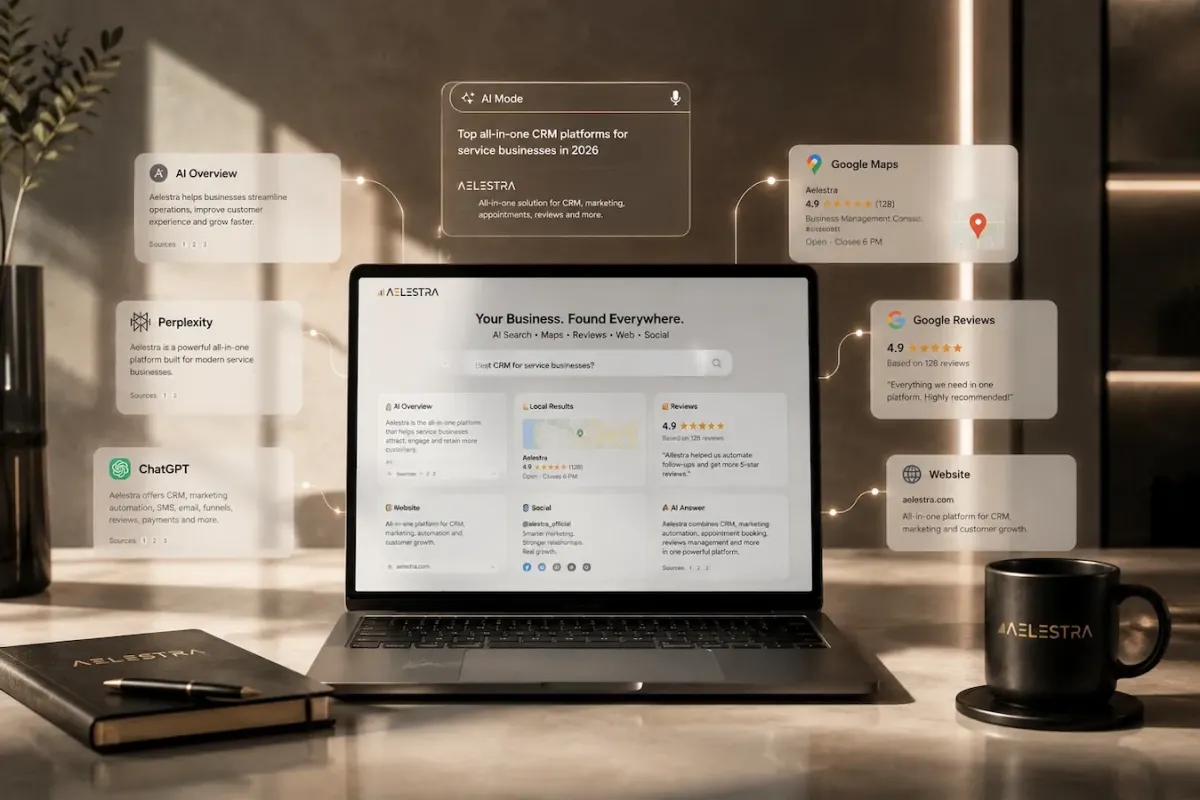
People increasingly ask questions directly inside Google AI Overviews, Google AI Mode, ChatGPT, Gemini, Perplexity, and other AI-powered discovery experiences. Instead of searching with two or three keywords, customers can now ask detailed questions such as:
“What is the best CRM for a service business that needs appointments, email marketing and customer follow-up?”
Or:
“Which local business near me has strong reviews and online booking?”
The answer may be generated before the customer ever reaches a traditional list of search results.
That creates one of the most important digital marketing questions of 2026:
When AI answers your customer’s question, will your business be part of the answer?
Google itself acknowledged this shift in May 2026 when it published new guidance specifically for succeeding in generative AI experiences in Search. Importantly, Google also clarified something many businesses misunderstand: there is no secret AI markup or shortcut. Strong technical SEO, helpful original content, crawlability, clear business information, quality media, structured data that accurately reflects the page, and good user experience remain foundational.
Welcome to the new era of AI Search Optimization, Answer Engine Optimization (AEO), Generative Engine Optimization (GEO), and modern SEO.
Search Has Changed - Customer Intent Hasn’t
Customers still want answers.
They still want to know:
Which company can solve their problem?
Which business can they trust?
What does a service cost?
Which solution fits their needs?
What do existing customers think?
What should they choose?
What has changed is where and how those answers are delivered.
HubSpot’s 2026 State of Marketing research reports that adapting SEO strategies to changes in organic and AI-powered search is one of marketers’ major priorities this year. Its AEO research also found that 58% of surveyed marketers say their businesses are already optimizing for answer engines, while 44% reported making a business purchase involving a brand they discovered through an answer engine.
For business owners, this is not simply another marketing trend.
It is a change in digital discovery.
SEO Is Not Dead, It Has Expanded
One of the biggest mistakes businesses can make in 2026 is believing that traditional SEO is obsolete.
It is not.
Google explicitly states that established SEO best practices remain relevant to its generative AI features because AI Overviews and AI Mode are connected to Google's existing search infrastructure and ranking systems.
The better way to think about modern visibility is:
SEO gets your business understood and discovered.
AEO helps your information become useful as a direct answer.
GEO considers how your brand and content may surface within generative experiences.
These strategies overlap considerably.
Your objective is therefore not to create content “for robots.”
It is to create the clearest, most useful, trustworthy and distinctive source on the questions your customers are actually asking.
1. Stop Writing Around Keywords. Start Answering Real Questions.
Traditional SEO often began with phrases such as:
“CRM software small business.”
AI search is increasingly conversational.
A prospect may instead ask:
“What software should I use if I need to manage leads, appointments, reviews and email marketing without paying for five different platforms?”
That difference matters.
Your website needs content addressing the complete customer problem, not merely repeating a keyword.
For AELESTRA, that means creating authoritative content around questions such as:
How can I manage customer leads more effectively?
How do I automate appointment follow-ups?
What is the best way to manage Google reviews?
How can I combine CRM and marketing?
How can I reduce the number of business tools I use?
How can AI answer calls and book appointments?
These are not simply blog subjects.
They are customer-intent signals.
2. Build Topical Authority Instead of Publishing Random Articles
One excellent article is useful.
A connected ecosystem of authoritative content is considerably stronger.
Suppose a company wants to establish expertise around customer relationship management. Instead of publishing one general CRM article, it could develop interconnected content covering:
CRM → lead management → sales pipelines → follow-ups → customer retention → email campaigns → reviews → customer analytics.
This creates topical authority.
Search engines gain a clearer understanding of what your business specializes in, while visitors can continue moving through related information.
This is exactly why the AELESTRA blog strategy should function as a series of content clusters, not unrelated weekly posts.
3. Create Content AI Can Understand, Without Making It Robotic
A well-optimized 2026 article should be easy for both humans and machines to interpret.
That means using:
A clear H1
Descriptive H2 and H3 headings
Direct answers to important questions
Short explanatory sections where appropriate
Relevant internal links
Accurate structured data
Helpful images and video
Clear brand and service information
FAQ sections based on genuine customer questions
Google specifically says that important content should remain available in textual form, internal links should make information discoverable, structured data should accurately represent visible content, and businesses should maintain accurate Business Profile information. Google also says there is no special AI-specific schema required simply to appear in AI Mode or AI Overviews.
That distinction matters.
Structure helps. Tricks do not.
4. Give AI Something Worth Citing
AI has created an extraordinary amount of generic content.
That makes generic content less valuable.
A business that simply publishes another version of “10 Tips for Better Marketing” is competing against millions of similar pages.
Instead, create information containing something distinctive:
Original expertise.
Real business experience.
Unique frameworks.
Industry-specific recommendations.
Case studies.
Customer questions.
Product knowledge.
Useful comparisons.
Expert perspectives.
Google's 2026 generative-search guidance specifically emphasizes valuable, unique, non-commodity content.
That is an important phrase for AELESTRA.
Our articles should not read like content written merely because a content calendar required a post.
They should demonstrate business expertise.
5. Strengthen Your Brand Entity Across the Web
AI search visibility is bigger than your website.
Search and answer systems may encounter signals associated with your business through:
Your website
Google Business Profile
Reviews
Social profiles
Business directories
Industry websites
Press coverage
Videos
Community discussions
Other authoritative references
Your company name, description, services, location information and positioning should therefore remain accurate and consistent wherever the brand appears.
Think of this as building a clearer digital identity.
The easier it is for search systems to understand:
who you are,
what you do,
who you serve,
where you operate,
and why you are credible,
the stronger your overall discovery foundation becomes.
6. Reviews Are Becoming Even More Important in AI Discovery
Reviews already influence customer decisions and local SEO.
In an AI-first discovery environment, reputation signals become even more strategically important because customers are increasingly asking recommendation-style questions:
“What is the best…?”
“Which company should I choose…?”
“What business has the strongest reputation…?”
That means a business with a strong, current and professionally managed online reputation enters 2026 with a significant advantage.
Businesses should actively:
Request authentic reviews
Respond professionally
Keep reviews fresh
Address negative experiences constructively
Maintain accurate local listings
Build evidence of real customer experience
This is also why AELESTRA's review management and AI Review Response capabilities belong inside a broader SEO strategy rather than being treated solely as customer-service tools.
7. Your Website Still Matters - Perhaps More Than Ever
There is a misconception that if AI provides answers directly, websites become less important.
The opposite is closer to reality for serious businesses.
AI systems still need reliable sources, and customers conducting high-intent research still need somewhere to verify a company, evaluate its offering and take action.
HubSpot's 2026 research suggests websites, blogs and SEO remain among the most impactful marketing channels, while AI search can move customers further through the research process before they arrive at a website.
That means the visitor who eventually reaches your website may be better informed and closer to making a decision.
Your site therefore needs to convert that intent immediately.
Fast pages.
Clear services.
Strong proof.
Simple booking.
Visible calls to action.
Professional design.
Easy communication.
8. Optimize for Discovery - Then Build the Journey After Discovery
Being mentioned by AI is not the final objective.
Revenue is.
Imagine a potential customer discovers your business through an AI-generated recommendation.
What happens next?
They visit your website.
Then perhaps:
AI Search → Website → Form → CRM → Follow-Up → Appointment → Payment → Review → Repeat Customer
This is where AELESTRA's broader architecture becomes strategically important.
AELESTRA can bring together the components behind that journey:
Website & funnels
CRM
Forms
Unified communication
Email & SMS
Automated workflows
Appointments
Payments
Reviews
Customer loyalty
AI discovery may generate the opportunity.
Your business infrastructure converts it.
9. Measure More Than Rankings
Traditional SEO measurement often focuses heavily on:
Ranking position → clicks → traffic.
AI search requires businesses to think more broadly.
Important 2026 visibility indicators can include:
Organic search impressions
Traditional ranking performance
AI-generated search visibility
Brand mentions
AI citations
Referral traffic from AI platforms
Lead quality
Conversion rate
Pipeline contribution
Revenue attribution
Google even began testing dedicated Generative AI performance reporting in Search Console in June 2026, giving participating sites more visibility into impressions occurring through generative Search experiences such as AI Overviews and AI Mode.
The goal is not simply:
“Did we rank?”
It is:
“Did our visibility produce meaningful business outcomes?”
The AELESTRA Approach: Build for People, Search Engines and AI Discovery
The businesses that succeed in this new environment will not chase every algorithm change.
They will build strong digital foundations.
A clear website.
Helpful content.
Structured customer data.
A credible reputation.
Consistent business information.
Strong customer experiences.
Connected marketing and CRM systems.
And technology capable of converting discovery into relationships.
AELESTRA's approach is centered around bringing those systems together.
Because in 2026, being online is no longer enough.
Your business needs to be understandable, discoverable, trustworthy - and ready to convert the moment opportunity arrives.
Final Takeaway
Google is not disappearing.
SEO is not disappearing.
But search is expanding.
Customers are moving between traditional search, AI answers, local results, social media, reviews and websites during the same decision journey.
The companies that respond now have an opportunity to establish authority while AI Search Optimization, AEO and GEO are still developing disciplines.
Do not build your visibility strategy around where customers searched yesterday.
Build it around where they are searching next.